
UK Accelerates Grid Transition Amid Renewable Push
National infrastructure upgrade targets net zero by 2050
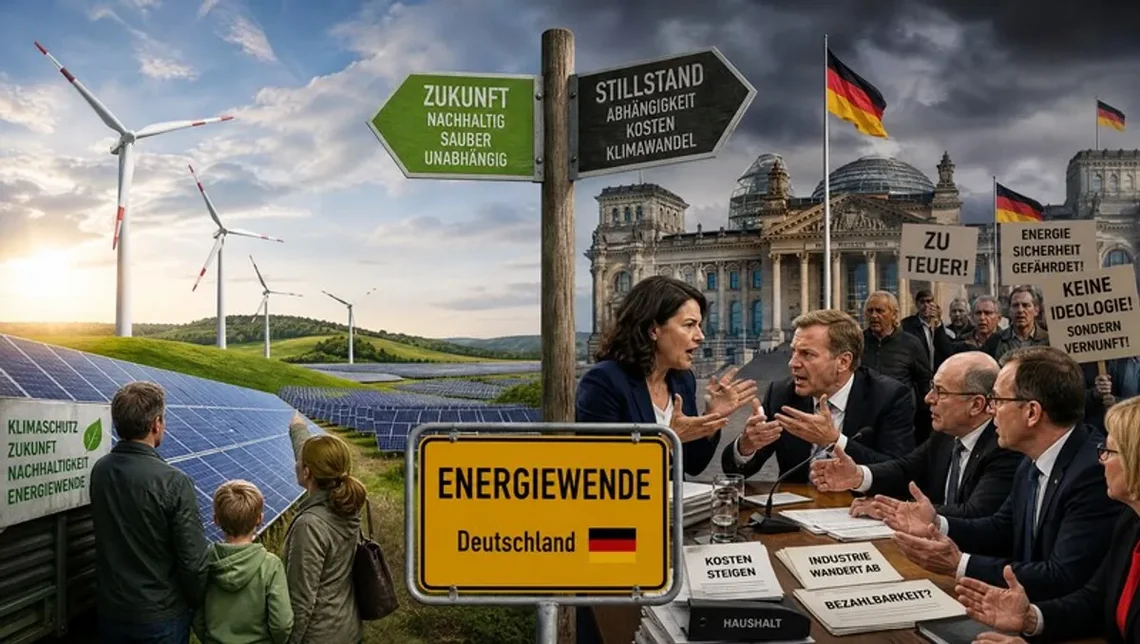
Britain is undertaking one of the most significant overhauls of its electricity infrastructure in decades, committing tens of billions of pounds to modernise the national grid and accelerate the shift away from fossil fuels as the government pursues a legally binding net zero target by 2050. The scale of investment — spanning offshore wind connections, long-distance transmission upgrades, and a new wave of grid storage technology — reflects both the urgency of decarbonisation commitments and the structural complexity of rewiring an economy still heavily dependent on gas-fired generation.
Climate figure: The UK power sector currently accounts for approximately 13% of national greenhouse gas emissions, down from nearly 40% two decades ago. The International Energy Agency projects that electricity systems worldwide must reach net zero by 2035 in advanced economies to keep global average temperature rise within 1.5°C above pre-industrial levels — a threshold the IPCC identifies as critical to avoiding the most severe climate impacts. (Source: IEA, IPCC Sixth Assessment Report)
The Scale of the Grid Challenge
Grid infrastructure in Britain was largely designed for a centralised, fossil-fuel-dominated system in which large power stations dispatched electricity in one direction — from plant to consumer. The rapid expansion of offshore wind, solar, and distributed energy resources has fundamentally altered that model, requiring investment in transmission capacity, flexibility services, and digital grid management that existing infrastructure was never built to handle.
National Grid ESO, the electricity system operator, has outlined plans requiring hundreds of new pylons, upgraded substations, and thousands of kilometres of new cabling — both overhead and subsea — to connect renewable energy zones in northern Scotland, the North Sea, and the Celtic Sea to population centres in England's Midlands and south. The project pipeline represents the largest expansion of British grid infrastructure since the postwar era, officials said.
Related Articles
Offshore Wind as the Central Variable
Offshore wind now generates a substantial share of UK electricity on high-output days, with installed capacity growing rapidly over the past decade. However, the geography of the best wind resources — concentrated off the coasts of Scotland, northeast England, and Wales — creates a structural mismatch with demand centres further south. New high-voltage direct current (HVDC) transmission links are central to resolving that bottleneck, according to energy analysts, with several major interconnector projects currently in planning or early construction phases.
For further detail on the government's offshore energy strategy, see the related coverage of UK Accelerates Renewable Energy Push Ahead of COP30, which examines ministerial commitments made in the lead-up to the next major UN climate summit.
Storage and Flexibility: The Missing Piece
Industry analysts and independent researchers have consistently identified grid-scale energy storage as the critical enabler for a high-renewables electricity system. Battery storage capacity in the UK has grown significantly in recent periods, but the volume required to balance a system increasingly dominated by variable generation remains far beyond what is currently deployed. Long-duration storage technologies — including compressed air, pumped hydro, and iron-air batteries — are attracting government and private investment, though most remain at early commercial stages, data from the Department for Energy Security and Net Zero show.
Policy Framework and Regulatory Context
The government's Clean Power Action Plan, published earlier this year, set out a framework requiring the electricity system to be powered overwhelmingly by clean sources well ahead of the 2050 net zero deadline — with interim milestones creating immediate pressure on developers, network operators, and regulators. The plan assigns Ofgem, the energy regulator, an explicit duty to facilitate the energy transition, a remit previously focused more narrowly on consumer price protection.
Analysts at Carbon Brief have noted that the regulatory shift is significant, arguing that Ofgem's historical conservatism on network investment contributed to bottlenecks that now require urgent and expensive remediation. The regulator has responded by fast-tracking approvals for several major transmission projects, though planning consent for new pylons and substations remains a source of local friction in rural areas of England and Scotland.
Planning Reform as an Accelerant
The government has moved to streamline the Nationally Significant Infrastructure Projects regime, reducing statutory consultation periods for grid infrastructure deemed essential to net zero delivery. Supporters argue the changes are necessary to close what officials describe as a multi-year gap between renewable energy capacity being built and the grid connections required to bring that power to market. Critics, including some environmental groups, have raised concerns that accelerated planning processes risk bypassing landscape and ecological assessments for sensitive sites, according to reporting by the Guardian Environment desk.
Investment Figures and Financing Structures
Public and private investment in UK grid infrastructure is now running at record levels, with estimates from the National Infrastructure Commission suggesting the sector requires sustained annual expenditure well into the 2030s to meet climate commitments. The government has indicated that the majority of this investment will come from the private sector, structured through regulated asset base models that allow network companies to recover costs through consumer bills over extended periods.
That financing model has attracted scrutiny from consumer groups, who note that electricity bill charges already include significant network cost components and that further grid investment will inevitably increase transmission charges unless offset by falling generation costs from mature renewables. The IEA has projected that the long-run cost of electricity in systems with high renewable penetration falls substantially once capital expenditure is amortised, though the transition period carries near-term cost pressures. (Source: IEA World Energy Outlook)
The Role of Green Finance and Public Capital
The National Wealth Fund — the government's newly restructured public investment vehicle — has been tasked with catalysing private capital for clean energy infrastructure, including grid assets. Officials said the fund would prioritise projects where private financing alone is insufficient, such as early-stage long-duration storage and grid connections in remote areas with limited commercial returns. The approach mirrors models adopted in Germany and the United States under the Inflation Reduction Act, where blended public-private financing has accelerated deployment of critical energy infrastructure, according to analysis published in Nature Energy.
Comprehensive reporting on the financial commitments underpinning these plans is available in UK Pledges Billions for Renewable Energy Grid Overhaul, which covers the specific funding allocations announced by the Treasury and the Department for Energy Security and Net Zero.
International Comparison: How the UK Stacks Up
Britain's grid transition is part of a broader global pattern, but the pace, structure, and ambition of national programmes vary considerably. The following table provides a comparative overview of selected countries' electricity sector decarbonisation progress and grid investment commitments, based on publicly available data from the IEA and national energy agencies.
| Country | Renewable Share of Electricity (approx.) | Net Zero Target | Grid Investment Focus | Key Challenge |
|---|---|---|---|---|
| United Kingdom | ~45% | 2050 (law) | Offshore wind transmission, HVDC links | Planning bottlenecks, storage scale-up |
| Germany | ~55% | 2045 (law) | North-south transmission corridors | Industrial load flexibility, gas phase-out pace |
| United States | ~23% | 2050 (executive) | Long-haul transmission, permitting reform | Fragmented regulatory landscape |
| Denmark | ~80% | 2050 (law) | Interconnection, energy islands | Seasonal storage, hydrogen integration |
| Australia | ~35% | 2050 (law) | Renewable energy zones, interstate links | Vast geography, coal region transition |
(Source: IEA Electricity Market Report; national energy agency data)
Risks, Delays, and Honest Assessments
Despite the ambition and investment volumes involved, independent analysts and parliamentary committees have identified a range of risks that could slow the transition. Supply chain constraints — particularly for specialist grid components including transformers, subsea cables, and power electronics — represent a near-term bottleneck that the government's acceleration agenda may intensify rather than resolve. Multiple countries pursuing simultaneous grid expansion programmes are competing for the same limited pool of manufacturing capacity, according to IEA analysis published this year.
Workforce availability is a related concern. The grid transition requires tens of thousands of additional engineers, electricians, and project managers across construction, operation, and digital systems management. Training pipelines lag behind projected demand, officials in the energy sector have acknowledged, pointing to a potential skills gap that could constrain delivery timelines regardless of planning or financing conditions.
For a candid account of where the programme faces the most serious headwinds, readers can consult UK Delays Net Zero Targets Amid Grid Transition Challenges, which examines specific instances where regulatory, logistical, and political pressures have pushed back delivery milestones.
Community Opposition and Local Impact
Large-scale grid infrastructure is not politically neutral. Proposals for new overhead transmission lines have met organised opposition in rural England and Scotland, where residents and some local authorities have argued that visual and environmental impacts are inadequately weighted against national energy priorities. The debate mirrors tensions seen in Germany's Energiewende, where north-south power line construction faced sustained legal and political challenges that delayed projects by years, according to Carbon Brief analysis of European grid expansion programmes.
The government has indicated it will consult on enhanced community benefit arrangements for areas hosting new grid infrastructure, following models used in the wind energy sector. Whether financial compensation will be sufficient to reduce planning friction at scale remains an open question, analysts said.
The Path to 2050 and Immediate Priorities
The technical and financial scale of Britain's grid overhaul is without modern precedent in the UK energy sector. Achieving a decarbonised electricity system requires not a single policy lever but the simultaneous execution of transmission expansion, storage deployment, demand-side flexibility, market reform, and workforce development — all within a compressed timeframe imposed by the physics of the climate system rather than the preferences of project managers.
The IPCC has been explicit that electricity sector decarbonisation is a foundational requirement for economy-wide net zero, as virtually every other sector — transport, heating, industry — depends on access to clean power for its own transition. That dependency makes grid investment a strategic priority rather than a sectoral concern, officials and independent researchers consistently argue.
Detailed technical analysis of the infrastructure programme now underway is available through UK Accelerates Electric Grid Overhaul Amid Renewable Push and UK Accelerates Net Zero Grid Overhaul Amid Climate Targets, which together provide a comprehensive account of the engineering, regulatory, and political dimensions of Britain's electricity sector transformation.
What is clear from the evidence base — from the IEA's modelling, the IPCC's physical science findings, Carbon Brief's policy tracking, and Nature's published research on energy systems — is that the window for an orderly, cost-effective transition is finite. The decisions made in the current period, on planning rules, financing structures, supply chain investment, and community engagement, will shape the trajectory of British energy infrastructure for the remainder of the century.