
UK Misses Interim Carbon Emissions Target
Government falls short of 2025 reduction goals
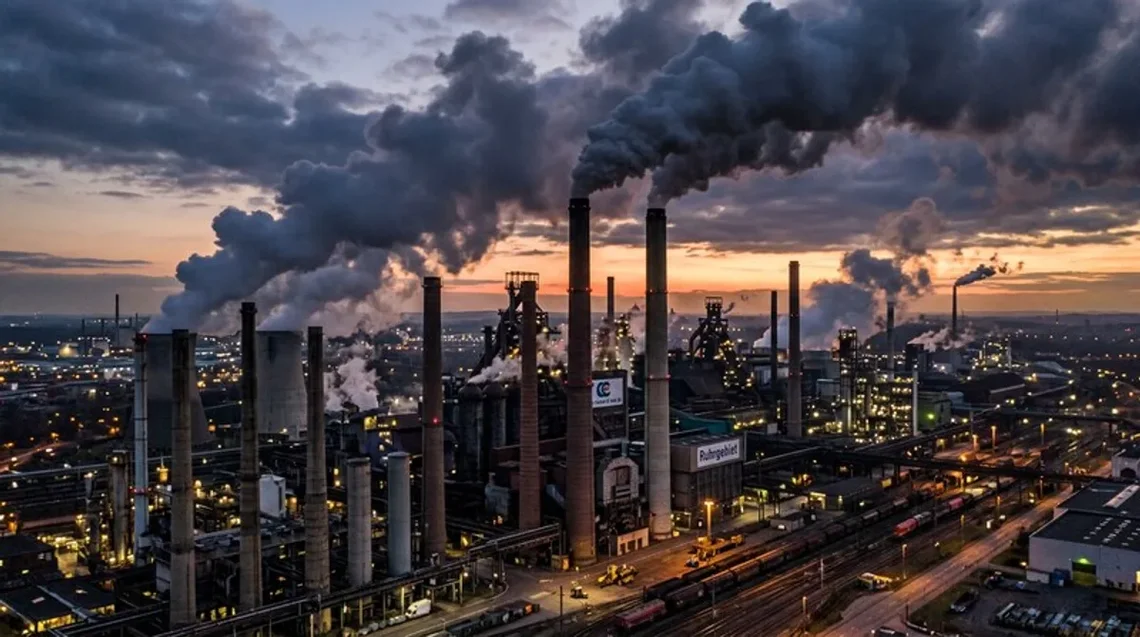
The United Kingdom has failed to meet its interim carbon emissions reduction target, with official statistics confirming that greenhouse gas output remains significantly above the benchmark required to keep the country on track for its legally binding net zero commitment by mid-century. The shortfall represents one of the most significant domestic climate policy failures in recent years and raises urgent questions about the credibility of Britain's decarbonisation roadmap.
Climate figure: UK greenhouse gas emissions currently stand at approximately 384 million tonnes of CO₂ equivalent per year, against an interim Carbon Budget 4 target requiring reductions to around 310 million tonnes. The UK's Climate Change Committee has warned that the country is on course to miss its 2030 and 2035 carbon budgets without substantial new policy action. Global mean surface temperature has already risen by approximately 1.1°C above pre-industrial levels, according to the IPCC Sixth Assessment Report.
What the Data Show
Provisional emissions figures released by the Department for Energy Security and Net Zero confirm that the UK has fallen short of the trajectory required under its fourth Carbon Budget, which covers the period through to the end of this decade. The data show overall emissions have declined in recent years, driven primarily by the near-complete phase-out of coal from electricity generation, but the pace of reduction has slowed markedly across key sectors including transport, buildings, and heavy industry.
How the Gap Was Calculated
The Carbon Budget framework, established under the Climate Change Act, sets legally binding limits on cumulative emissions across five-year periods. Analysis from Carbon Brief indicates that while the electricity sector has broadly delivered on its decarbonisation promise, other sectors have lagged considerably. Heat from buildings — where roughly 85 percent of homes still rely on gas boilers — remains one of the most intractable challenges, with heat pump deployment running well below the government's own projections.
Related Articles
The Climate Change Committee, the independent statutory body tasked with advising government on climate targets, has warned in successive annual progress reports that the UK's policy framework contains a "substantial and growing gap" between stated ambitions and the concrete measures required to achieve them. Officials said the committee's assessment makes clear that ambition alone is insufficient without delivery mechanisms backed by sustained public investment and regulatory certainty.
Sectors Driving the Shortfall
Transport remains the single largest source of domestic greenhouse gas emissions in the UK, accounting for roughly a quarter of the national total. The transition to battery electric vehicles has accelerated in recent years, with sales of new petrol and diesel cars declining, but the overall vehicle fleet is turning over slowly and emissions from aviation and shipping — both difficult to abate — continue to complicate the picture.
Buildings and Heat
The residential and commercial buildings sector represents one of the most politically sensitive and technically complex areas of decarbonisation. The government's decision to delay the ban on new gas boiler installations — originally set for this decade — drew sharp criticism from climate analysts and environmental groups, who argued the move sent a damaging signal to both industry and consumers. According to data reviewed by the Climate Change Committee, the rate of energy efficiency retrofit in existing housing stock remains far below what is needed, with low-income households disproportionately exposed to both energy costs and carbon-inefficient homes. (Source: Climate Change Committee)
Industry and Agriculture
Heavy industry, including steel, cement, and chemicals, faces particular challenges because many of the emissions involved are process-related and cannot simply be eliminated by switching fuel sources. Carbon capture, utilisation and storage technology — long promoted by successive governments as a key part of the solution — remains in early-stage deployment in the UK, with commercial-scale projects only recently entering construction phases. Agriculture, responsible for around ten percent of UK emissions, has seen limited policy intervention to date, and methane from livestock and nitrous oxide from soils remain largely unaddressed by current regulatory frameworks. (Source: Department for Energy Security and Net Zero)
International Context and Comparisons
The UK's difficulties in meeting interim targets are not unique among major economies, but they are notable given Britain's historical role in championing global climate ambition, including hosting the COP26 summit. Analysis from the International Energy Agency indicates that while global clean energy investment has reached record levels, emissions reductions are not yet tracking in line with pathways consistent with limiting warming to 1.5°C above pre-industrial levels. (Source: IEA)
| Country / Bloc | 2030 Emissions Target | Current Trajectory Status | Primary Policy Lever |
|---|---|---|---|
| United Kingdom | 68% reduction vs 1990 | Off track — policy gap identified | Renewables, EV mandate, heat pumps |
| European Union | 55% reduction vs 1990 | Partially on track — variable by member state | Emissions Trading System, Fit for 55 |
| United States | 50–52% reduction vs 2005 | Uncertain — policy continuity questioned | Inflation Reduction Act tax credits |
| Germany | 65% reduction vs 1990 | Ahead in power sector, lagging in transport | Renewable energy expansion, carbon pricing |
| Canada | 40–45% reduction vs 2005 | Off track — significant gap remains | Carbon tax, clean fuel standard |
Research published in the journal Nature has consistently found that national pledges submitted under the Paris Agreement, in aggregate, remain insufficient to limit warming to internationally agreed thresholds. The science is clear: without a steep acceleration in policy delivery across all major emitting nations, the physical risks associated with climate change — including more frequent extreme weather events, sea level rise, and disruption to food systems — will intensify. (Source: Nature)
Government Response and Policy Commitments
Ministers have pointed to the government's clean power action plan, which sets an ambition to fully decarbonise the electricity system within this decade, as evidence of serious intent. Officials said the expansion of offshore wind capacity, investment in grid infrastructure, and the relaunch of nuclear power development all form part of a credible long-term strategy. The government has also reaffirmed its commitment to the Climate Change Act and its targets, insisting that the current shortfall reflects the inherent difficulty of systems change at scale rather than any retreat from net zero ambition.
Critics and the CCC's Assessment
Independent analysts and environmental groups have pushed back on this framing. The Climate Change Committee's most recent progress report to Parliament stated that the number of policy areas rated as "on track" has declined in successive years, and that credible plans are missing across the majority of the sectors that need to decarbonise. Carbon Brief analysis has further highlighted that the UK's emissions reduction rate has slowed substantially compared to the period of rapid coal phase-out, and that replicating that pace across harder-to-abate sectors will require a qualitatively different scale of intervention. (Source: Carbon Brief)
Writing in its environment coverage, the Guardian has documented growing concern among scientists and former government advisers that political volatility — including repeated changes to heat pump policy, confusion over electric vehicle mandates, and delays to the energy efficiency scheme — has undermined investor confidence and slowed the supply chain development needed to deliver decarbonisation at pace. (Source: Guardian Environment)
What Needs to Happen Next
For detailed reporting on the specific mechanisms behind the UK's carbon accounting shortfall, readers can refer to UK misses net zero interim target by wide margin, which examines the sectoral breakdown in greater depth. The political and legislative implications of the missed target are explored in UK misses interim net zero target, raises 2035 questions, a companion piece assessing whether the government's medium-term milestones remain achievable under current policy settings.
The Role of Finance and Investment
Economists and climate finance specialists have long argued that the pace of private investment in low-carbon infrastructure is closely correlated with regulatory certainty. When governments signal ambivalence about timelines — through delayed bans, watered-down incentive schemes, or mixed messaging on carbon pricing — the result is typically a slowdown in capital allocation to the sectors that need it most. The IEA has estimated that achieving net zero globally by mid-century would require clean energy investment to roughly triple from current levels, with a disproportionate share needing to flow to emerging markets and developing economies. (Source: IEA)
In the UK domestic context, the Treasury's approach to green investment incentives has been the subject of ongoing debate. Business groups have called for a more coherent industrial policy framework, comparable in structure — if not in scale — to the United States Inflation Reduction Act, arguing that without long-term fiscal signals, manufacturers and infrastructure developers face an unacceptable level of policy risk.
Looking Ahead to the Next Carbon Budget
The Climate Change Committee is expected to publish its advice on the UK's seventh Carbon Budget in due course, setting out the level of ambition required for the period approaching mid-century. That process will take place against a backdrop of intensifying scientific evidence on climate impacts — the IPCC has made clear that every fraction of a degree of warming avoided translates into materially reduced physical and economic risk — and increasing international pressure ahead of forthcoming UN climate negotiations. (Source: IPCC)
For further analysis of how the current target miss was first flagged by official monitoring bodies, see UK misses interim net zero targets, report warns. A more granular assessment of how close the UK came to meeting the threshold — and what that margin implies for future budget compliance — is available in UK misses net zero interim target by narrow margin.
The central challenge facing policymakers is not a lack of technical solutions — the pathways to decarbonisation are well understood and increasingly cost-competitive — but rather the political will and institutional capacity to implement them at the necessary speed and scale. Whether the current government, and any that follow, will rise to that challenge remains the defining question for UK climate policy in the years ahead.