
Ukraine accelerates NATO membership bid amid renewed Russian strikes
Kyiv pushes for fast-track accession as fighting intensifies
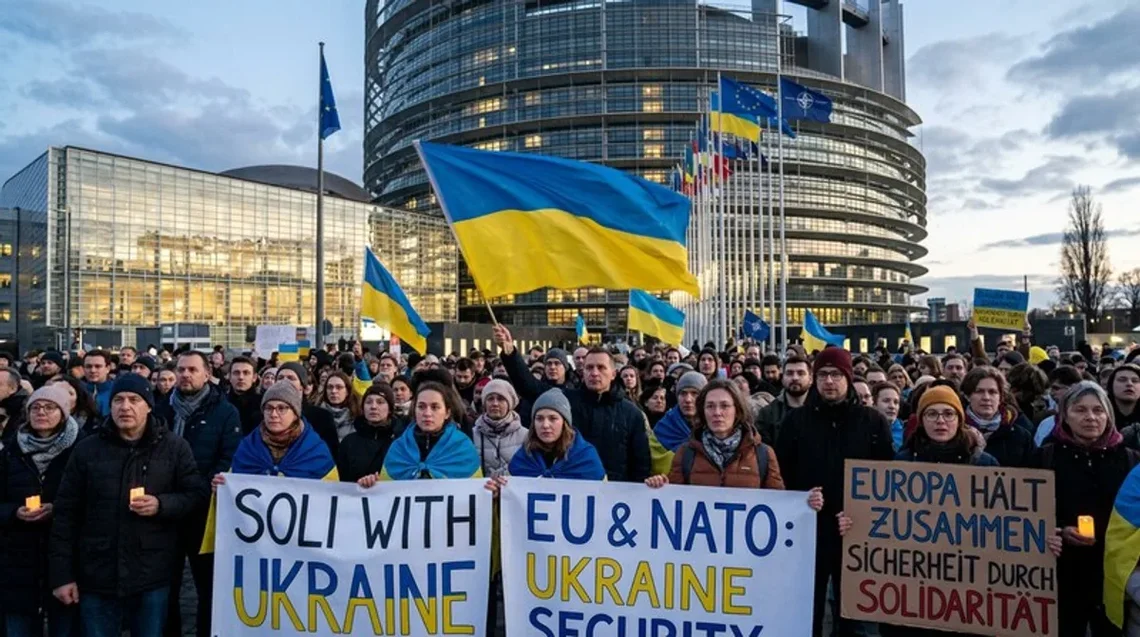
Ukraine has formally intensified its push for NATO membership, with President Volodymyr Zelensky calling on alliance leaders to set a concrete accession timeline as Russian missile and drone strikes continue to pound Ukrainian cities, killing dozens of civilians in recent weeks. The renewed diplomatic offensive comes as Kyiv argues that full membership — not merely weapons deliveries — represents the only durable security guarantee capable of ending the war on terms favourable to Ukraine and to European stability.
Key Context: Ukraine applied for expedited NATO membership in late 2022, shortly after Russia's illegal annexation of four Ukrainian regions. While NATO leaders at the Washington Summit reaffirmed that Ukraine's membership path is "irreversible," no formal invitation has been extended, with the United States and Germany among those urging caution until active hostilities conclude. Ukraine currently holds Enhanced Opportunities Partner status — the highest tier short of full membership. (Source: NATO)
Zelensky Escalates Membership Diplomacy
Ukrainian officials have redoubled lobbying efforts across NATO capitals, framing the membership question not as a post-war aspiration but as an urgent wartime necessity. Zelensky addressed NATO foreign ministers in recent weeks, arguing that an invitation — even without immediate Article 5 activation in active combat zones — would fundamentally alter Russia's strategic calculus and reduce the incentive to prolong hostilities, officials said.
The Ukrainian president has also sought to reframe the debate around economic and political costs to NATO members of an indefinite war. According to officials familiar with the diplomatic exchanges, Kyiv has presented data showing that sustained conventional military support without a membership pathway is both costlier and less strategically coherent than a defined accession process with transitional security arrangements. (Source: Reuters)
Related Articles
The "Irreversible Path" Language and Its Limits
NATO's Washington Summit communiqué described Ukraine's membership path as "irreversible," language that Kyiv welcomed but which critics described as deliberately ambiguous. The phrase carries no legal obligation, no timeline, and no triggering conditions, according to analysts cited by Foreign Policy. Ukrainian officials have since pushed for concrete benchmarks — democratic governance milestones, defence sector interoperability standards, and anti-corruption thresholds — that, once met, would automatically advance the accession process regardless of the battlefield situation.
That proposal has found sympathy in the Baltic states and Poland, but faces resistance from larger alliance members wary of provoking a direct NATO-Russia confrontation. The internal alliance tension is well-documented: as explored in our coverage of how Ukraine seeks fresh NATO backing amid renewed Russian offensive, the gap between declaratory support and binding commitment remains one of the defining fault lines within the alliance.
Russian Strikes Intensify Pressure on Civilians and Infrastructure
The diplomatic push is unfolding against a backdrop of sustained and intensifying Russian aerial bombardment. Russian forces have launched repeated large-scale Shahed drone and ballistic missile salvoes targeting Ukrainian energy infrastructure, port facilities, and residential areas, officials said. The UN Office for the Coordination of Humanitarian Affairs has recorded a significant rise in civilian casualties compared to the preceding quarter, with attacks on healthcare facilities drawing particular condemnation from UN human rights monitors. (Source: UN)
Energy Infrastructure as Strategic Target
Russian strikes have systematically targeted Ukraine's power generation and distribution networks, according to Ukrainian energy ministry officials. Substations, thermal power plants, and hydroelectric facilities have been struck repeatedly, leaving millions of Ukrainians facing rolling blackouts during winter months. The pattern of attacks, according to AP reporting, reflects a deliberate strategy to erode civilian resilience and increase pressure on Kyiv to negotiate on Russian terms.
The energy dimension of the conflict has direct implications for European supply chains and energy pricing, a point reinforced in recent briefings by the International Energy Agency. European governments have accelerated plans to provide Ukraine with mobile generation units and spare transformer components, though logistical constraints have slowed delivery timelines. (Source: AP)
Air Defence Gaps Exploited by Russian Forces
Ukrainian air defence systems, while substantially reinforced by Western deliveries of Patriot batteries, IRIS-T systems, and NASAMS, remain insufficient to intercept the volume and variety of Russian projectiles being deployed, military analysts said. Russia has adapted its tactics, combining slower Shahed drones with faster ballistic and hypersonic missiles to overwhelm integrated air defence networks. The operational challenge is detailed in our reporting on how Ukraine seeks new NATO air defense as Russia intensifies strikes, with Kyiv formally requesting additional interceptor stockpiles and radar systems from alliance partners.
NATO Allies Navigate Support vs. Escalation Risk
NATO member states continue to debate the pace and scope of military assistance to Ukraine, with the core tension remaining between providing sufficient support to prevent Ukrainian defeat and avoiding actions that could be characterised by Moscow as direct alliance belligerence. The United States, United Kingdom, France, and Germany have all expanded their support packages in recent months, though with varying restrictions on weapons use inside Russian territory. (Source: Reuters)
The broader trajectory of alliance coordination is reflected in the pattern of collective decisions: as documented in our analysis of how NATO allies boost Ukraine aid amid renewed Russian offensive, member states have progressively lifted earlier restrictions on long-range strike systems while stopping short of committing combat forces. The logic, officials said, is to ensure Ukrainian survivability without crossing the threshold that could trigger a broader European conflict.
The Long-Range Strike Debate
Permission for Ukraine to use Western-supplied long-range missiles against targets inside Russia — including military logistics hubs, airfields, and command nodes — has been among the most contested policy questions within the alliance. The United Kingdom and France have been comparatively permissive; the United States has maintained a more cautious posture, approving limited strike authorities while retaining the right to revoke them if escalation risks rise, officials said. (Source: Foreign Policy)
Ukraine has argued consistently that restricting long-range strike capability amounts to fighting the war with one hand tied behind its back. Russian forces have used depth — stationing aircraft, munitions depots, and command infrastructure well behind front lines — specifically to exploit these limitations, Ukrainian military officials said.
What This Means for the UK and Europe
For the United Kingdom and its European partners, Ukraine's NATO membership bid is not an abstract geopolitical question — it carries direct implications for defence spending, treaty obligations, and the long-term architecture of European security. British officials have consistently expressed support for Ukraine's eventual NATO membership in principle, while maintaining studied ambiguity on timelines, reflecting the tension between public support for Ukraine and caution about binding commitments that could draw Britain into direct conflict with Russia.
The UK's bilateral security agreement with Ukraine, signed earlier this year, provides a partial bridge — committing London to long-term military assistance, intelligence sharing, and defence industrial cooperation — but falls explicitly short of the Article 5 mutual defence guarantee that NATO membership would confer. European governments face the same structural dilemma: bilateral arrangements and continued weapons deliveries can sustain Ukrainian resistance but cannot substitute for the deterrence value of full alliance membership.
Economically, the war's continuation imposes compounding costs on European economies through energy market volatility, refugee integration pressures, and the reallocation of defence budgets. The European Commission has estimated that reconstruction costs for Ukraine currently exceed one trillion dollars, with European taxpayers expected to bear a substantial portion through international lending mechanisms and direct grants. (Source: AP)
For European defence industries, Ukraine has simultaneously exposed capacity gaps and created production incentives. NATO's collective effort to sustain Ukrainian forces has revealed critical shortfalls in ammunition stockpiles, air defence interceptors, and armoured vehicle production across member states — shortfalls that governments are now scrambling to address through accelerated procurement. The cumulative picture of alliance capability-building is traced in our report on how NATO allies bolster Ukraine aid amid Russian offensive.
The Path Forward: Conditions, Timelines, and Red Lines
Diplomats and analysts broadly agree that Ukraine's formal NATO accession is unlikely while active large-scale hostilities continue, given the risk of triggering immediate Article 5 obligations against a nuclear-armed adversary. The more realistic near-term scenario, officials said, involves a negotiated accession framework that sets out phased conditions — institutional reforms, interoperability milestones, ceasefire or armistice arrangements — while providing Ukraine with credible interim security guarantees.
The Role of US Electoral Politics
The trajectory of NATO's Ukraine policy is inseparable from American domestic politics. Shifts in Washington's posture — whether toward sustained engagement or conditional support — directly determine the alliance's operational capacity and political cohesion. European governments have responded by accelerating plans to increase indigenous defence production and reduce dependence on US military stockpiles for Ukrainian support, though analysts caution that full strategic autonomy remains years away. (Source: Foreign Policy)
The Ukrainian military's own operational posture has adapted to the evolving support environment. As examined in our coverage of how Ukraine pushes deeper into Russian territory amid NATO support surge, Kyiv has used periods of enhanced Western support to conduct cross-border operations and maintain battlefield pressure, aiming to demonstrate strategic agency rather than passive reliance on alliance decisions.
| Country / Entity | Position on Ukraine NATO Membership | Key Bilateral Action | Status |
|---|---|---|---|
| United States | Supports eventual membership; opposes immediate invitation | Security assistance packages; limited long-range strike authority | Conditional support |
| United Kingdom | Supports membership in principle; ambiguous on timeline | Bilateral security agreement; Storm Shadow deliveries | Strong bilateral partner |
| Germany | Cautious; opposes invitation during active hostilities | Taurus missile debate ongoing; Patriot battery supplied | Significant but contested |
| France | Supportive; open to broader intervention debate | SCALP missiles; military trainer discussions | Increasingly active |
| Poland | Strong advocate for immediate invitation | Major logistics hub; substantial equipment transfers | Frontline ally |
| Baltic States (Estonia, Latvia, Lithuania) | Unconditional advocates for full membership | Proportionally largest aid contributions relative to GDP | Most urgent advocates |
| NATO (collective) | "Irreversible path" — no formal invitation issued | Enhanced Opportunities Partner status; interoperability programmes | Declaratory commitment only |
The coming months will test whether NATO's collective political will can translate declaratory commitments into binding structural arrangements before Ukrainian battlefield conditions — or domestic political shifts in key member states — foreclose the options currently on the table. What remains unambiguous, officials and analysts said, is that the outcome of Ukraine's NATO bid will define the security architecture of Europe for a generation, with consequences that extend far beyond Kyiv's borders to the streets of London, Berlin, Warsaw, and Tallinn alike. The stakes, as Russia continues its aerial campaign against Ukrainian civilians, could hardly be higher.