
Ukraine Pushes Forward as NATO Vows Sustained Support
Alliance reinforces commitment amid ongoing Russian resistance
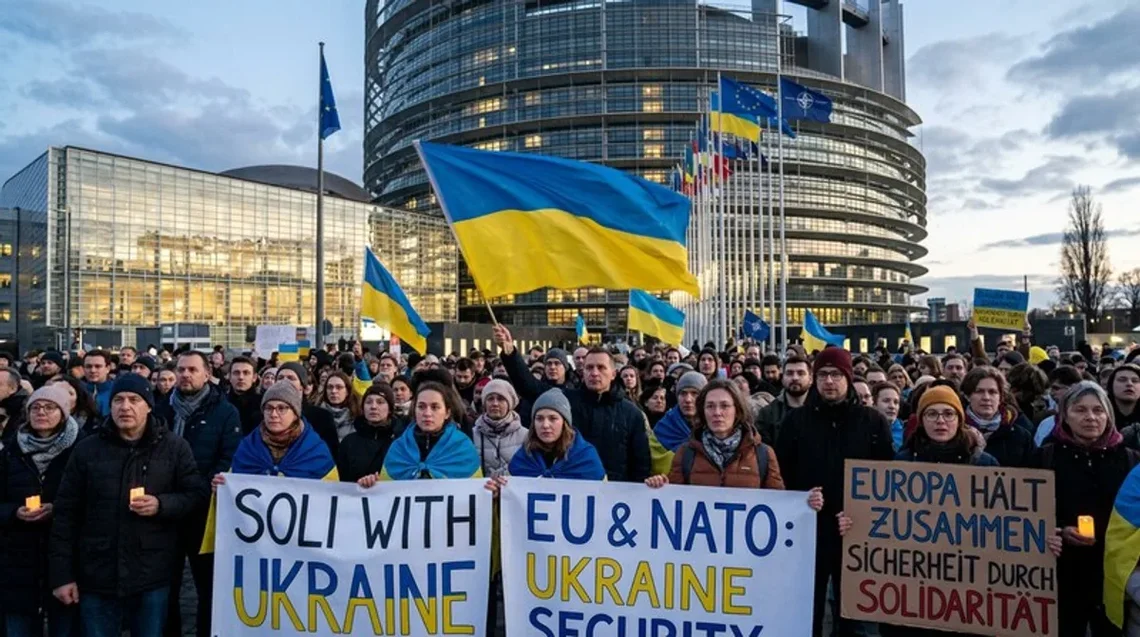
Ukrainian forces have continued to press advances along multiple front lines while NATO foreign ministers, meeting in Brussels, reaffirmed the alliance's long-term commitment to Kyiv's defence, pledging sustained military aid and financial support as Russian resistance hardens across the east and south of the country. The pledge comes amid intensified drone and missile strikes on Ukrainian cities and renewed diplomatic pressure on Western governments to maintain unity as the conflict enters a critical phase.
Key Context: Ukraine has received more than $200 billion in combined military, financial, and humanitarian assistance from Western allies since the full-scale Russian invasion began, according to the Kiel Institute for the World Economy. NATO currently has over 40,000 troops on its eastern flank in an enhanced forward presence stretching from the Baltic states to Romania. The United Kingdom has committed more than £12 billion in support to Ukraine, making it one of Kyiv's largest bilateral donors outside the United States. Russia controls approximately 18 percent of Ukrainian territory, including Crimea, which it illegally annexed, and large portions of the Donetsk, Luhansk, Zaporizhzhia, and Kherson oblasts. (Source: Kiel Institute for the World Economy; NATO)
Front-Line Situation: Pressure in the East and South
Ukrainian military officials confirmed this week that their forces are engaged in active combat operations in the Donetsk region, where Russian troops have concentrated significant firepower and personnel in an effort to capture the logistically vital city of Pokrovsk. Ukrainian ground commanders described the situation as "extremely difficult but stable," according to a statement from the General Staff of the Armed Forces of Ukraine. Elsewhere, incremental Ukrainian advances have been reported near Zaporizhzhia, where drone warfare has become increasingly central to tactical operations on both sides.
The Role of Long-Range Weapons
The provision of long-range strike capabilities by Western allies has remained a defining issue. Ukraine has used Storm Shadow cruise missiles, supplied by the United Kingdom and France, to strike Russian logistics hubs and ammunition depots deep behind the front lines, officials said. American-supplied ATACMS missiles have similarly been used in high-value strikes, according to Pentagon briefings. These weapons have given Kyiv a qualitative edge that partially offsets Russia's numerical superiority in artillery and manpower, analysts at the International Institute for Strategic Studies have noted. (Source: International Institute for Strategic Studies)
Related Articles
Russian Aerial Campaign Escalates
Russia has intensified its aerial campaign against Ukrainian civilian infrastructure, launching coordinated waves of Shahed-136 drones and ballistic missiles at energy facilities, railways, and residential areas. According to AP, Ukrainian air defences intercepted a significant proportion of incoming projectiles during the most recent salvos, but strikes on power generation infrastructure continued to cause widespread disruption. UN humanitarian officials warned that civilian casualties have risen sharply in recent weeks, with displacement figures continuing to climb toward the seven million internally displaced persons already documented inside Ukraine. (Source: United Nations Office for the Coordination of Humanitarian Affairs)
NATO's Brussels Commitment: What Was Agreed
At the Brussels ministerial, NATO Secretary General Mark Rutte underscored that alliance support for Ukraine is "not charity — it is an investment in our own security," according to a statement issued by NATO headquarters. Foreign ministers from all 32 member states endorsed a communiqué reaffirming Ukraine's path toward NATO membership, though the timeline for accession remains undefined and a matter of internal alliance debate. Crucially, ministers confirmed the continuation of the NATO Security Assistance and Training for Ukraine mission, which coordinates equipment deliveries and provides training to Ukrainian personnel outside of Ukrainian territory.
Funding Mechanisms Under Scrutiny
A central point of discussion in Brussels was the long-term funding architecture for Ukrainian support. Several European member states have pushed for a formalised multi-year financing instrument to reduce dependence on annual national budget decisions, which are increasingly vulnerable to domestic political shifts. The proposal mirrors the framework already partially adopted through the European Union's Ukraine Facility, a 50 billion euro package approved earlier to provide macro-financial assistance through to the end of the decade. (Source: European Commission)
Related alliance posture developments are tracked in detail in our coverage of how NATO bolsters its eastern flank amid Russia concerns, a process that has accelerated considerably since Russia's full-scale invasion.
Western Sanctions: Maintaining Economic Pressure on Moscow
Parallel to the military support framework, Western governments have continued to expand and refine sanctions regimes targeting the Russian economy. The European Union has adopted successive packages targeting Russian oil revenues, financial institutions, and dual-use goods exports. Enforcement has become a growing concern, however, with evidence mounting that Russia is routing sanctioned goods through third-country intermediaries in Central Asia, the South Caucasus, and the Gulf region, Reuters reported. (Source: Reuters)
The EU's most recent measures, which expanded the list of restricted entities and tightened controls on shadow fleet tankers carrying Russian crude, are detailed in our reporting on how EU tightens Russia sanctions over Ukraine offensive — a process that has drawn repeated warnings from Moscow about retaliatory economic measures.
A broader set of measures targeting Russian exports and financial mechanisms was also addressed in the context of our earlier analysis of the EU tightening Russia sanctions over the Ukraine stalemate, which examined the diminishing returns of incremental economic pressure absent stronger enforcement mechanisms.
Russia's Economic Resilience: A Contested Assessment
Western officials have consistently maintained that sanctions are degrading Russia's war-making capacity over time, pointing to elevated inflation, labour shortages, and the forced redirection of civilian industrial capacity toward military production. Independent economists, however, present a more nuanced picture. Russia's GDP has continued to grow in nominal terms, driven by war spending and high energy revenues, though the structural distortions embedded in a war economy are expected to generate compounding costs over the medium term, according to analysis published by Foreign Policy. (Source: Foreign Policy)
The United Nations: Paralysis and Humanitarian Action
At the United Nations Security Council, diplomatic efforts to broker a ceasefire or establish protected humanitarian corridors have remained deadlocked, owing primarily to Russia's veto power as a permanent member. The council's inability to act has pushed humanitarian coordination to subsidiary UN bodies and regional frameworks, with limited effectiveness in areas of active combat. Our ongoing coverage of the UN Security Council deadlock on Ukraine aid corridors documents the repeated failure of diplomatic mechanisms to secure safe passage for civilians.
Humanitarian Toll: Numbers That Matter
The UN Human Rights Monitoring Mission in Ukraine has verified more than 12,000 civilian deaths since the full-scale invasion began, with the actual figure believed to be considerably higher due to access restrictions in occupied territories. More than six million Ukrainians remain refugees in Europe, with the largest concentrations in Germany, Poland, and the Czech Republic, according to data published by the United Nations High Commissioner for Refugees. The humanitarian burden on host nations has generated both solidarity and strain, particularly in countries managing parallel domestic cost-of-living pressures. (Source: UNHCR; UN Human Rights Monitoring Mission in Ukraine)
Questions over potential arms embargo proposals at the Security Council level are explored in our analysis of the UN Security Council deadlock on the Ukraine arms embargo, which examines the structural limits of international law in the current geopolitical environment.
What This Means for the United Kingdom and Europe
For the United Kingdom, the conflict in Ukraine is not a distant geopolitical abstraction. British officials have repeatedly framed support for Kyiv as a direct investment in national and European security, arguing that a Russian victory in Ukraine would fundamentally alter the security architecture of the continent. The UK government has maintained one of the most robust support packages among European allies, encompassing artillery ammunition, air defence systems, training programmes for Ukrainian soldiers on British soil, and diplomatic leadership within the G7 framework.
Economically, the war continues to exert upward pressure on energy prices across Europe, though the acute shock of the post-invasion energy crisis has been partly absorbed through diversification of supply and the rapid expansion of liquefied natural gas import capacity. The longer the conflict continues, the more European governments face difficult conversations about defence spending commitments — NATO's target of two percent of GDP is now a floor rather than an aspiration for many member states, with several moving toward three percent planning scenarios, officials said.
For the broader European project, the war has accelerated conversations about strategic autonomy, European defence industrial capacity, and the extent to which the continent can sustain a credible deterrence posture independently of American political will. The election of a more transactional leadership in Washington has sharpened these questions considerably, pushing European capitals to invest more urgently in joint procurement, interoperability, and long-term defence production contracts.
Outlook: A Prolonged Contest
Analysts across the major Western policy institutions broadly concur that the conflict is unlikely to be resolved through a near-term negotiated settlement on terms acceptable to either side. Ukraine has ruled out any agreement that cedes territory or sovereignty, while Russia's stated war aims remain expansive. The most plausible near-term trajectory, according to assessments cited by Reuters and AP, is continued attritional warfare along a largely static front, punctuated by periodic offensive operations on both sides, with the outcome shaped significantly by the durability of Western political and financial commitment to Kyiv. (Source: Reuters; AP)
| Country | Total Committed Aid (Approx.) | Military Focus | Notable Contributions |
|---|---|---|---|
| United States | $110 billion+ | Air defence, artillery, ATACMS | Patriot systems, M1 Abrams tanks, ammunition |
| United Kingdom | £12 billion+ | Long-range strike, training | Storm Shadow missiles, Challenger 2 tanks, pilot training |
| Germany | €28 billion+ | Air defence, armour | Leopard 2 tanks, IRIS-T systems, Gepard AA |
| France | €3 billion+ (military) | Artillery, missiles | SCALP missiles, Caesar howitzers, Mirage jets pledged |
| Poland | $4 billion+ (military) | Armour, ammunition | T-72 tanks, MiG-29 aircraft, artillery rounds |
| Canada | CAD $9 billion+ | Armour, financial | Senator APCs, artillery, financial guarantees |
What is clear is that the war in Ukraine has become the defining security challenge of this era for Europe and the broader Western alliance. NATO's renewed commitment in Brussels carries tangible weight, but its ultimate significance will be measured not in communiqués but in the consistency of material support delivered to Ukrainian forces over the months ahead. For the United Kingdom and its European partners, the choices made now will shape the security environment of the continent for a generation. (Source: NATO; Reuters; AP; Foreign Policy)