UK Pledges Billions for Renewable Energy Grid Overhaul
Major investment targets net zero infrastructure by 2035
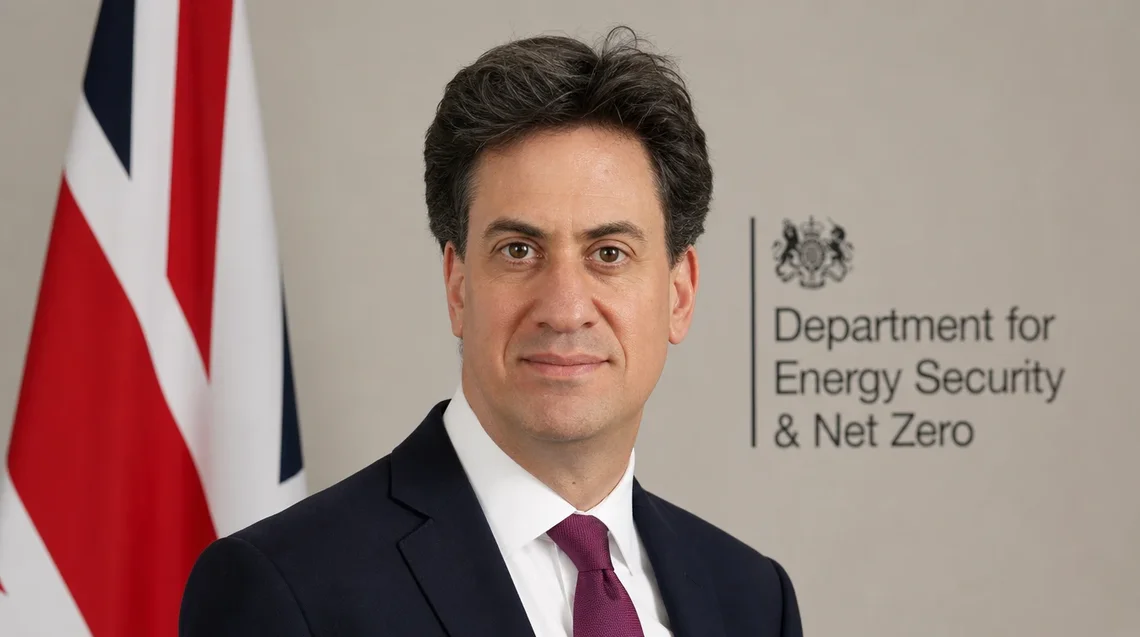
The UK government has announced a multi-billion-pound investment package to overhaul the national electricity grid, with officials pledging that clean energy sources will power the majority of Britain's electricity demand by the middle of this decade and that net zero infrastructure targets will be met by 2035. The announcement, described by energy ministers as the most significant public commitment to grid modernisation in a generation, draws on recommendations from international bodies and builds on years of incremental progress in renewable deployment.
Climate figure: The Intergovernmental Panel on Climate Change (IPCC) has established that limiting global average temperature rise to 1.5°C above pre-industrial levels requires global net CO₂ emissions to fall by approximately 45 percent from current levels by 2030, reaching net zero around mid-century. The UK's own Climate Change Committee has calculated that the power sector must be fully decarbonised before the broader economy can credibly achieve net zero — making grid investment a foundational, not peripheral, policy priority. (Source: IPCC Sixth Assessment Report; Climate Change Committee)
What the Investment Package Contains
Officials confirmed that the funding commitment spans transmission infrastructure, offshore and onshore wind connection capacity, long-duration energy storage, and smart grid technology. The package is structured across both public capital allocation and regulated private investment channelled through Ofgem's existing price control framework, with additional incentives for community energy schemes in devolved nations.
Energy security and net zero officials said the investment would directly address what the International Energy Agency (IEA) has identified as one of the primary structural bottlenecks in clean energy transition: the chronic under-investment in grid infrastructure relative to generation capacity. The IEA has repeatedly noted in recent annual outlooks that grid expansion globally has failed to keep pace with the rapid deployment of wind and solar assets, leaving renewable capacity stranded or curtailed. (Source: IEA World Energy Outlook)
Related Articles
Transmission and Connection Priorities
A central component targets the high-voltage transmission backbone connecting Scotland's substantial wind resource — both onshore and offshore — to major demand centres in England and Wales. National Grid Electricity System Operator, now operating as the newly constituted National Energy System Operator (NESO), is expected to accelerate planning consent processes for new pylons and underground cables under powers granted by the recently passed Energy Act, officials said.
Analysts at Carbon Brief have noted that grid connection queues in the UK have expanded dramatically in recent years, with thousands of gigawatts of proposed renewable projects awaiting access, far exceeding plausible near-term deployment. Reforms to the connection queue — prioritising shovel-ready projects over speculative applications — are expected to be codified alongside the funding announcement. (Source: Carbon Brief)
Storage and Flexibility Mechanisms
Long-duration energy storage, including grid-scale battery systems and emerging technologies such as compressed air and liquid air storage, is allocated a distinct funding stream. Officials said that without adequate storage, the reliability of a predominantly renewable grid cannot be guaranteed, particularly during periods of low wind and solar generation in winter months. The government's Longer Duration Energy Storage Roadmap, published previously, has informed the allocation priorities contained within the new package, according to departmental briefing documents.
How the UK Compares Internationally
Britain's grid investment commitment arrives in the context of accelerating clean energy spending globally. The IEA has recorded that clean energy investment worldwide is now running at nearly twice the level of fossil fuel investment, a structural shift that has intensified since the passage of the United States Inflation Reduction Act and the European Union's Net Zero Industry Act. (Source: IEA)
| Country / Bloc | Clean Energy Investment (recent annual estimate) | Grid Decarbonisation Target Year | Renewable Share of Electricity (approximate) |
|---|---|---|---|
| United Kingdom | £20–25 billion (public + regulated) | 2035 | ~50% (wind, solar, hydro combined) |
| Germany | €50+ billion (federal + Länder) | 2035 | ~60% |
| United States | $300+ billion (IRA-leveraged) | 2035 (federal target) | ~25% |
| European Union | €600 billion (REPowerEU framework) | 2030–2035 (member-state range) | ~45% |
| China | $890 billion (IEA estimate) | Peak carbon 2030; neutrality 2060 | ~32% and rising rapidly |
(Source: IEA World Energy Investment Report; Carbon Brief; European Commission)
The UK's per-capita spending commitment is broadly competitive with Germany, though analysts have cautioned that raw investment figures do not capture the quality of regulatory frameworks, planning systems, or supply chain depth — all areas where Britain still faces structural constraints, according to research published in Nature Energy. (Source: Nature Energy)
Policy Context and Legislative Background
The announcement follows a period of acknowledged difficulty for the government's net zero programme. As reported in detail by Guardian Environment, successive independent assessments have found the UK off-track against its statutory carbon budgets, with transport, heating, and agriculture sectors falling behind the trajectory required by law. (Source: Guardian Environment)
Readers seeking detailed analysis of those shortfalls can refer to earlier ZenNewsUK coverage examining how the government failed to meet interim net zero emissions milestones and what that means for industrial policy and household energy costs. A more granular breakdown of the 2035 question specifically is available in the report on whether the net zero target remains credible given current policy velocity.
Planning Reform as an Enabling Condition
Officials have been explicit that financial commitment alone is insufficient. The speed at which new grid infrastructure can be consented and built is a binding constraint, and the government has introduced reforms to the Nationally Significant Infrastructure Project regime intended to cut average consenting times for major transmission assets from the current decade-long average to under four years. Environmental groups have broadly welcomed the acceleration while calling for robust habitat and biodiversity protections to be maintained throughout the planning process, according to statements from Wildlife and Countryside Link.
The interaction between planning reform and investment certainty is well-documented in energy economics literature. Research published in Nature Climate Change has found that regulatory predictability is among the most significant determinants of private capital deployment in grid infrastructure — more significant, in many modelling scenarios, than the headline size of public subsidy packages. (Source: Nature Climate Change)
The Role of Contracts for Difference
The Contracts for Difference (CfD) scheme, through which the government provides long-term price stability for renewable generators, remains the central market mechanism underpinning the investment. Officials indicated that the strike price trajectory and auction round frequency would be adjusted to reflect the cost reductions achieved in offshore wind and to stimulate deployment in emerging technologies, including tidal stream and floating offshore wind, where the UK holds a comparative geographic advantage. The most recent CfD allocation round demonstrated renewed industry confidence after a previous round in which no offshore wind projects bid successfully due to cost inflation, officials said.
Progress Already Made and Remaining Distance
The UK's trajectory in renewable deployment is genuinely substantive. As documented across multiple independent analyses and covered in depth in ZenNewsUK's report on how the UK renewable energy sector has surged past coal in electricity generation terms, Britain now generates more electricity from wind, solar, and other clean sources than from all fossil fuel sources combined across full-year measurement periods. Coal has been effectively eliminated from the generation mix, a transition that took less than a decade from majority reliance.
Offshore wind capacity has grown from negligible to world-leading on a per-capita basis. The UK currently hosts more installed offshore wind capacity than any other country, a position supported by favourable North Sea wind resource, established supply chains in northern English port towns, and accumulated regulatory experience. (Source: IEA; Carbon Brief)
Gaps That Remain
Despite this progress, significant structural gaps remain. Electricity represents only a fraction of total UK energy consumption once heat and transport are included. The decarbonisation of heat — overwhelmingly dependent on natural gas through the national grid of domestic boilers — remains the single largest unsolved challenge in UK climate policy, according to analysis from the Climate Change Committee. Grid electrification of heat through heat pumps requires not only the clean electricity supply that the current investment targets, but also substantial upgrades to local distribution networks not fully addressed in the current package, analysts said.
Similarly, industrial process heat, green hydrogen production, and the electrification of freight all place additional future demands on grid capacity that planners must account for now, given the long lead times of infrastructure construction. The IEA has estimated that the global electricity grid must expand by the equivalent of the entire current US grid roughly every decade to keep pace with electrification demand. (Source: IEA)
Scrutiny, Scepticism, and Political Economy
The announcement has not been received without scrutiny. Opposition politicians have questioned whether the spending commitments represent genuinely new money or the repackaging of previously announced figures. Energy economists cited by Carbon Brief have asked whether the regulatory structures — particularly Ofgem's approach to allowed returns for network companies — are sufficiently attractive to mobilise private capital at the scale required within the stated timeline. (Source: Carbon Brief)
There is also the broader question of delivery credibility. The government's record on major infrastructure projects — in energy and across other sectors — has been marked by cost overruns, delays, and policy reversals. Coverage tracking the government's stated acceleration of the net zero grid overhaul has previously noted the gap between ambition as announced and deployment as achieved. Independent monitoring by the Climate Change Committee and scrutiny by parliamentary select committees will be essential accountability mechanisms as implementation proceeds, analysts said.
Consumer advocates have also raised questions about cost allocation. Major grid upgrades are ultimately recovered through network charges embedded in energy bills, and with household energy costs having risen sharply in recent years, the distributional impact of investment cost recovery is a live political issue. Officials have pointed to falling wholesale renewable generation costs as the long-run offset, an argument with substantial empirical support from IEA data but one that operates over a different time horizon than the near-term bill impact felt by households. (Source: IEA)
Outlook and Next Steps
The immediate next steps involve the publication of a detailed infrastructure delivery plan, expected to specify project-by-project timelines and funding allocations. NESO is expected to release an updated network requirements study that will form the technical foundation for prioritisation decisions. Ofgem's next price control review will codify the allowed investment envelope for regulated network companies over the coming multi-year period.
Whether the ambition articulated in this announcement translates into operational infrastructure within the 2035 window will depend on factors that financial pledges alone cannot resolve: planning system performance, supply chain capacity for specialised equipment such as high-voltage cables and substations, skilled workforce availability, and the ability of successive governments to maintain policy continuity through electoral cycles. Those systemic conditions, as much as the headline investment figure, will determine whether Britain achieves a genuinely decarbonised power system within the stated timeframe.
For readers tracking the full arc of UK clean energy policy, ZenNewsUK's ongoing coverage includes detailed analysis of the government's broader domestic agenda, including separate infrastructure commitments in health and public services covered in reporting on Prime Minister Starmer's NHS overhaul pledge, which shares the same political context of a government navigating large-scale public investment commitments against a constrained fiscal backdrop.