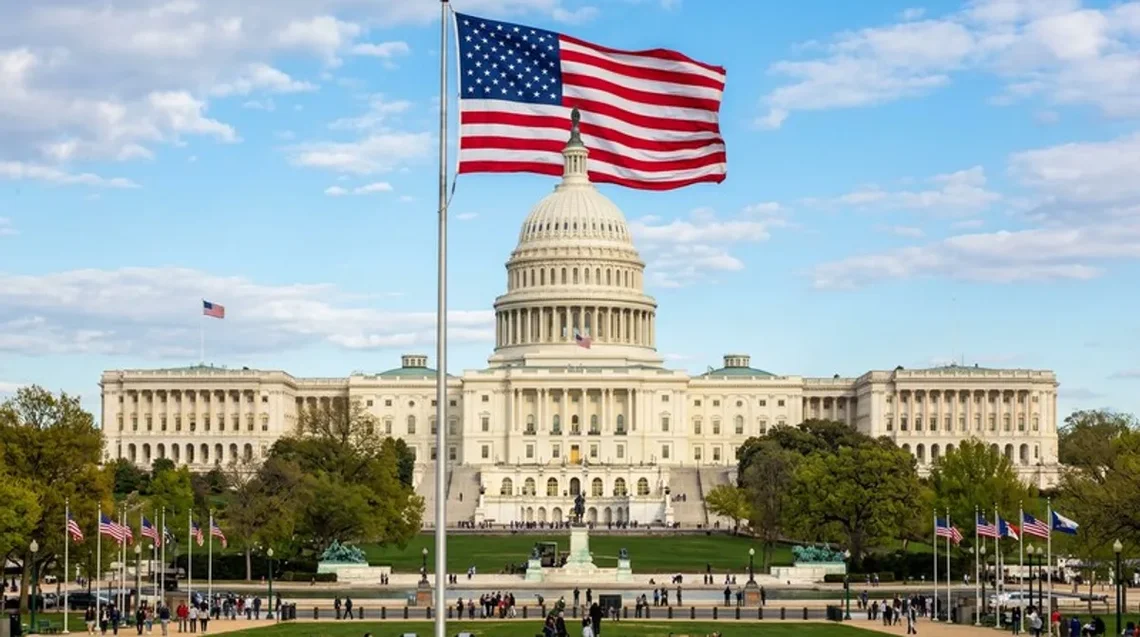
Senate Republicans block Democrats' immigration reform bill
Measure fails on party-line vote amid 2026 campaign tensions

Senate Republicans voted unanimously on Wednesday to block a sweeping Democratic immigration reform bill, defeating the measure on a strict party-line vote and deepening the legislative deadlock over border and immigration policy ahead of the midterm election cycle. The bill, which would have created new pathways to legal residency for millions of undocumented immigrants while expanding work visa programmes, fell well short of the 60-vote threshold required to advance under Senate cloture rules.
Key Positions: Republicans argued the bill represented an "amnesty" measure that would incentivise further illegal border crossings and failed to address enforcement gaps; Democrats contended the legislation was a pragmatic and overdue fix to a broken immigration system, incorporating border security provisions alongside humanitarian protections; the White House expressed support for the Democratic bill and criticised Republican obstruction, calling on the Senate to advance "common-sense" immigration reform that addressed both border management and pathways to legal status for long-term residents.
The Vote and Its Immediate Fallout
The final procedural tally stood at 47 in favour and 51 against, with no Republicans crossing the aisle and no Democrats defecting. Independent senators caucusing with Democrats voted in favour of the measure. The result marks at least the third time in recent years that comprehensive immigration legislation has died in the Senate on a procedural vote, according to congressional records reviewed by AP.
Cloture Failure and What It Means
Under Senate rules, advancing most major legislation requires 60 votes to invoke cloture and end debate — a threshold that effectively demands bipartisan cooperation in a chamber where neither party currently holds a supermajority. Democrats have repeatedly argued the 60-vote filibuster rule has become an instrument of minority obstruction; Republicans counter that it protects deliberative governance and prevents narrow majorities from ramming through sweeping policy changes. Wednesday's cloture failure ensures the bill will not receive a floor vote, barring a dramatic and unlikely procedural reversal, officials said.
Related Articles
For context on the pattern of blocked immigration legislation, see the earlier reporting on a Senate Republicans block immigration bill in party-line vote, which traced how similar procedural barriers have halted border and immigration measures across successive Congresses.
What the Bill Contained
The Democratic-sponsored legislation ran to several hundred pages and covered a broad range of immigration policy areas, according to a summary released by the Senate Judiciary Committee. Its central provisions included a phased pathway to legal permanent residency for undocumented individuals who have lived continuously in the United States for a qualifying period, an expansion of the H-2A agricultural worker visa programme, increased resources for immigration courts to reduce a backlog that currently stretches into the millions of cases, and new asylum processing standards intended to comply with both domestic law and international obligations.
Border Security Provisions
In an attempt to win over moderate Republicans, the bill's sponsors included additional funding for Customs and Border Protection, enhanced surveillance technology at ports of entry, and a series of measures targeting smuggling networks, officials familiar with the drafting process said. Critics on the Republican side argued those provisions were insufficient and would be rendered meaningless if accompanied by what they characterised as a blanket legalisation programme. Senior Republican senators told reporters the enforcement measures were "window dressing" designed to provide political cover for a bill that was fundamentally about expanding legal status for those who entered the country without authorisation.
Economic Projections from the CBO
An analysis conducted by the Congressional Budget Office projected that the bill, if enacted, would reduce the federal deficit over a ten-year window by a net figure driven largely by increased payroll and income tax revenues from newly legalised workers entering the formal economy. The CBO also projected modest upward pressure on wages in certain sectors and noted that expanded legal labour supply could help address shortages in agriculture, construction, and healthcare industries. Republicans disputed those projections, citing alternative analyses that pointed to potential costs in social services and public benefits. (Source: Congressional Budget Office)
| Metric | Figure | Source |
|---|---|---|
| Senate cloture vote — For | 47 | Senate record |
| Senate cloture vote — Against | 51 | Senate record |
| Votes required to advance (cloture threshold) | 60 | Senate rules |
| US public support for pathway to citizenship for long-term undocumented residents | ~68% | Gallup |
| Share of Americans rating immigration as a top national priority | ~52% | Pew Research |
| Estimated undocumented population in the US | ~11–12 million | Pew Research |
| Immigration court case backlog (approximate) | 3+ million cases | Congressional Budget Office |
Republican Opposition and the Party's Electoral Calculus
Senate Republicans emerged from a closed-door conference meeting ahead of the vote unified in their opposition, with senior members framing their position in terms of both policy substance and political accountability to constituents who have consistently ranked border security among their top concerns. The Republican leader argued from the Senate floor that Democrats were bringing a bill to a vote not because they expected it to pass but to generate campaign material ahead of the next electoral cycle, Reuters reported.
Swing-State Dynamics
Several Republican senators up for re-election in competitive states nonetheless held firm against the bill, a sign that the party's base-mobilisation strategy on immigration outweighs any cross-pressures from Latino voters or business community advocates in those states, according to analysts. Polling data from Gallup shows that immigration consistently ranks among the top two or three issues for Republican primary voters, giving incumbents little incentive to break from the party line on a high-profile vote that will feature prominently in opposition advertising. (Source: Gallup)
The dynamics surrounding this vote bear close resemblance to the political positioning documented in earlier coverage of the Senate Republicans block Democratic immigration bill episode, when a previous iteration of broadly similar legislation met an equivalent procedural fate.
Democratic Strategy and Internal Tensions
Democratic leaders acknowledged privately that they did not expect the bill to pass but argued the vote served an important purpose in drawing a clear contrast with Republicans ahead of the campaign season. Senate Majority Leader's office framed the vote as forcing Republicans on record against measures that polling suggests enjoy broad public support, including the pathway to citizenship provision, which Gallup data shows is backed by roughly 68 per cent of American adults. (Source: Gallup)
Progressive vs. Moderate Divisions
Within the Democratic caucus, the bill represented a carefully negotiated compromise that left neither progressive nor moderate members fully satisfied, officials said. Immigration advocates on the left argued the bill did not go far enough in protecting asylum seekers and included enforcement mechanisms they found objectionable. Moderates in swing districts and states worried that leading with immigration reform could expose them to attacks from the right, preferring to see the party focus on economic messaging. The fact that the bill attracted unified Democratic support in the cloture vote masked those underlying tensions, which are expected to resurface when the question of the party's 2026 legislative and campaign agenda is more formally debated.
The pattern of Democrats using immigration votes strategically, and the risks that carries, is analysed further in the background reporting on when Senate Democrats blocked a Trump immigration bill, which examined how both parties have used procedural votes on immigration as political instruments rather than genuine legislative vehicles.
Public Opinion and the Broader Policy Context
Pew Research data show that immigration has become one of the most politically polarised issues in the United States, with partisan gaps in attitudes toward immigration levels, enforcement priorities, and pathways to legal status wider than at any point in decades of survey research. While a majority of Americans across partisan lines express support for some form of legal status for long-term undocumented residents, views diverge sharply on the question of enforcement priorities and whether legalisation should be tied to specific border security benchmarks. (Source: Pew Research)
The Court Backlog Crisis
One area where there is broader bipartisan acknowledgement of a systemic problem is the immigration court backlog, which has grown to more than three million pending cases and in some jurisdictions means applicants wait years for a hearing, according to figures cited in the Congressional Budget Office analysis. Immigration judges, prosecutors, and advocacy groups across the political spectrum have described the backlog as a humanitarian and administrative crisis that undermines both enforcement and due process. The Democratic bill's provisions to fund additional immigration judges and streamline case processing had drawn tentative interest from some Republican staffers earlier in negotiations, before the broader legalisation provisions became the dominant point of contention, officials familiar with those discussions said. (Source: Congressional Budget Office)
What Comes Next
With the bill effectively dead for this congressional session, attention shifts to whether Democrats will attempt to advance narrower, targeted measures — focused on specific populations such as recipients of the Deferred Action for Childhood Arrivals programme, or on particular visa categories — that might attract at least some Republican votes. AP reported that Senate Democratic leadership has not ruled out such an approach but has not committed to a timeline. Bipartisan negotiations on immigration have collapsed and restarted multiple times in recent years, and veteran Senate observers expressed scepticism that the political conditions for a genuine compromise are present in the current climate.
The White House, for its part, reiterated its support for a comprehensive approach and placed blame squarely on Republican senators for what officials described as prioritising political obstruction over policy solutions. Republicans rejected that framing, arguing the administration's own border management record had undermined any case for expanding legalisation without first demonstrating effective enforcement.
The vote adds another chapter to what has become one of the longest-running legislative impasses in recent American political history. For a full timeline of how the current standoff evolved from earlier confrontations, the detailed account in Senate Democrats blocking a GOP immigration bill provides essential context on how the impasse reached its current state, with both parties now seemingly more invested in the issue as a campaign weapon than as a problem to be solved before the next election.